Archives
- 2026-04
- 2026-03
- 2026-02
- 2026-01
- 2025-12
- 2025-11
- 2025-10
- 2025-09
- 2025-03
- 2025-02
- 2025-01
- 2024-12
- 2024-11
- 2024-10
- 2024-09
- 2024-08
- 2024-07
- 2024-06
- 2024-05
- 2024-04
- 2024-03
- 2024-02
- 2024-01
- 2023-12
- 2023-11
- 2023-10
- 2023-09
- 2023-08
- 2023-07
- 2023-06
- 2023-05
- 2023-04
- 2023-03
- 2023-02
- 2023-01
- 2022-12
- 2022-11
- 2022-10
- 2022-09
- 2022-08
- 2022-07
- 2022-06
- 2022-05
- 2022-04
- 2022-03
- 2022-02
- 2022-01
- 2021-12
- 2021-11
- 2021-10
- 2021-09
- 2021-08
- 2021-07
- 2021-06
- 2021-05
- 2021-04
- 2021-03
- 2021-02
- 2021-01
- 2020-12
- 2020-11
- 2020-10
- 2020-09
- 2020-08
- 2020-07
- 2020-06
- 2020-05
- 2020-04
- 2020-03
- 2020-02
- 2020-01
- 2019-12
- 2019-11
- 2019-10
- 2019-09
- 2019-08
- 2019-07
- 2019-06
- 2019-05
- 2019-04
- 2018-07
-
Mammalian cells contain significant amounts of
2020-10-12
Mammalian cells contain significant amounts of a relatively lesser known enzyme that shows marked specifity for ether lipids containing AA and other 20–22 carbon fatty acids. This enzyme is called CoA-independent transacylase (CoA-IT), and transfers polyunsaturated moieties of 20–22 carbons, typical
-
Methacholine MCh is a bronchoconstrictive agent that has bee
2020-10-12
Methacholine (MCh) is a bronchoconstrictive agent that has been widely used in the diagnoses of airway narrowing and hyperresponsiveness (Jonasson et al., 2009). MCh induces muscle contractions by stimulating the muscarinic cholinergic receptors that are found in both the airways and the lung parenc
-
ER stress was monitored by both
2020-10-12
ER stress was monitored by both an increase of the ER chaperone (GRP78, GRP94) and the activation of the ER resident caspase-12. ER stress response (also known as the unfolded protein response) is a defense mechanism against various cellular stresses which causes accumulation of unfolded proteins in
-
In an effort to discover additional GPCRs directing the migr
2020-10-12
In an effort to discover additional GPCRs directing the migratory events of responding B cells, we identified Epstein-Barr virus (EBV)-induced gene 2 (EBI2) as a promising candidate. The gene encoding EBI2 (Ebi2, also known as Gpr183) was originally identified together with Ebi1 (Ccr7) as the most h
-
Crystallographic and NMR based analyses have revealed that
2020-10-10
Crystallographic and NMR-based analyses have revealed that RINGs and U-boxes have a common mode of interaction with E2s (Fig. 2A). The key structural elements are two loop-like regions, which, in the case of RINGs, coordinate Zn. The loops surround a shallow groove formed by the central α-helix. Tog
-
One of the hallmarks of the terminal stages
2020-10-10

One of the hallmarks of the terminal stages of apoptosis is the fragmentation of chromosomal DNA that proceeds in a two-step manner: the DNA is initially cleaved into 50–300kb fragments and eventually into oligonucleosomal pieces [12], [13]. The two major apoptotic nucleases are DNA fragmentation fa
-
br Enzymes involved in microbial steroid degradation are
2020-10-10
Enzymes involved in microbial steroid degradation are generally not expressed constitutively, but they are upregulated depending on which steroid substrates are present [17,81]. Thus, a cell-free extract prepared from testosterone-adapted C. testosteroni ATCC 11996 cells displayed a 1(2)-dehydroge
-
It is interesting to note that oligomerization
2020-10-10

It is interesting to note that oligomerization of recombinant DDR1 ECD primarily occurred when the protein was incubated with collagen in solution and to a much lesser extent when collagen was pre-immobilized on a surface as reported in our earlier studies (Agarwal et al., 2007). We believe that pre
-
Overexpression of EP and DDR has been sporadically reported
2020-10-10
Overexpression of EP300 and DDR1 has been sporadically reported in the pathogenesis of pulmonary fibrosis and other fibrotic diseases. Zeng et al. reported that EP300 was increased in TGF-β1 treated lung fibroblasts and mediated decreases of SIRT1 expression. Bhattacharyya et al. found that both EP3
-
br Acknowledgments br Introduction Cysteinyl leukotrienes Cy
2020-10-10

Acknowledgments Introduction Cysteinyl leukotrienes (CysLTs), LTC4, LTD4 and LTE4, are 5-lipoxygenase pathway metabolites of arachidonic tbtu mg and deeply involved in bronchial asthma via activation of CysLT1 receptors [1], [2]. Specific CysLT1 receptor antagonists, including pranlukast [3],
-
Investigations of mice lacking up to three CDKs identified
2020-10-10
Investigations of mice lacking up to three CDKs identified the mitosis-regulating kinase CDK1 as the main essential component for the cell cycle, whereas ablation of other XEN445 regulators such as CDK2, CDK4, or CDK6 did not result in defective proliferation 12, 13. Mouse models and specific CDK in
-
Under optimized assay conditions very
2020-10-10
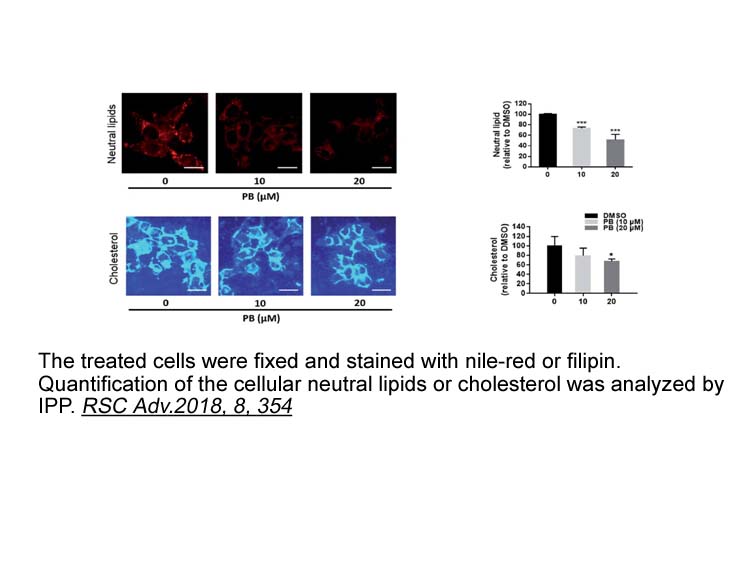
Under optimized assay conditions, very low concentrations (20pM) of [125I]YP20 bound to hCRF1-CHO HBC membranes with high specificity (>95% inhibited by 1μM astressin) and in a membrane protein-dependent manner. Specific binding was selective vs. the hCRF2α subtype because little specific binding w
-
In humans individual differences in prefrontal dopamine are
2020-10-10
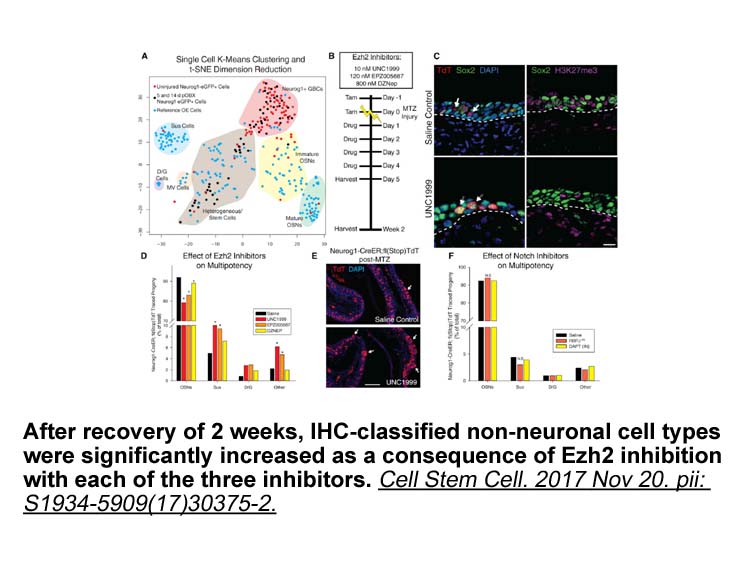
In humans, individual differences in prefrontal dopamine are partially caused by the Val158Met single-nucleotide polymorphism on the catechol-O-methyltransferase gene (COMT). This gene controls activity of the COMT enzyme, which degrades extracellular catecholamines including dopamine. The Val varia
-
In humans the ER is encoded by
2020-10-09

In humans, the ERα is encoded by the gene ESR1, located on chromosome 6, locus 6q25.1 (Gosden, Middleton, & Rout, 1986). In addition to the full-length ERα isoform (66kDa), several shorter isoforms (36kDa, 46kDa) have been identified as a result of the presence of alternate start codons, or as produ
-
lamotrigine receptor In the present study we first examined
2020-10-09

In the present study, we first examined the in vivo and ex vivo effects of androgens on ep1 lamotrigine receptor in the olfactory rosette of male B. sinensis. Thereafter, we cloned two different B.sinensis ar cDNAs and investigated their roles in the effects of 11-KT on ep1 expression. Material a
16080 records 800/1072 page Previous Next First page 上5页 796797798799800 下5页 Last page